

Our homes and our communities play important roles in our overall health, happiness, and independence. In a recent AARP Home and Community Preferences Survey, 75 percent of adults over age 50 expressed a preference to remain in their current home as long as possible—what is commonly referred to as “aging in place.”
What is aging in place? It is the ability to live in the place you call home and, in your community, independently and safely, as you age.
Aging in place is an admirable, realistic goal; however, if you don’t do an honest assessment and take steps to implement improvements, it’s only an aspiration. The objective should be to make your living space more age-friendly, implementing changes that benefit all ages in living safely and comfortably.
The best time to start to implement aging in place strategies is before you need them. Don’t wait for a crisis, such as a slip on a throw rug resulting in a broken hip (falls are the number one reason for emergency room visits for older adults) before making improvements.
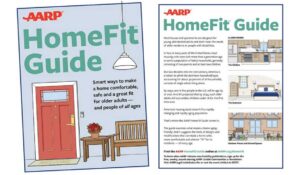
One of the best resources we’ve found to put aging in place goals into practice for a residence is the AARP HomeFit Guide. This downloadable resource is comprehensive, thoughtful, and available in English, Spanish, Chinese, Korean, and Vietnamese.
The HomeFit Guide provides over 100 tips with room-by-room recommendations. The guide works whether you rent or own, and regardless of where you live, be it an apartment, mobile home, condo, or single-family dwelling.
The guide also addresses technology, outdoor and shared spaces, and tenant rights, and offers quick fixes to get you started. The HomeFit webpage offers videos and a checklist, too.
Let’s look at some of the Quick Fixes on page 34 to get started with making your home a safer place and more supportive of your independence.
As the guide emphasizes, these are “simple solutions that will make a home safer, more efficient and a better ‘fit’ without having to hire a contractor or invest a lot of money in supplies. In fact, some instant improvements are free!”
Some Quick Fixes to Make a Home Safer
- Replace throw rugs with cushioned, slip-resistant mats. Or use double-sided carpet tape to secure existing floor coverings.
- Secure electrical and telephone cords along a wall, where they won’t be a tripping hazard.
- Store flashlights throughout the home in case of a power outage. Regularly test to check the batteries.
- Replace light bulbs that are too dim or too bright with long-lasting, energy-efficient bulbs. (Check the wattage ratings on the light fixtures to avoid installing bulbs that are too powerful.) If a stool or ladder is needed to reach any fixtures, ask someone to serve as a spotter.
- Install motion-sensor night-lights in hallways and bathrooms, near steps and along staircases.
- Install an address number that will be visible to first responders, especially at night.
Some Quick Fixes to Make a Home a Better ‘Fit’
- Store reading glasses or a magnifying glass wherever help might be needed for reading small print.
- Locate a bench or table outside the entry door for placing bags when unlocking the door. Also locate a piece of furniture inside for setting down packages and putting shoes on or taking them off.
- Rearrange the contents of kitchen cabinets so frequently used items are in easy to reach locations.
- Add baskets or bins to areas prone to floor clutter.
Other projects may require specific skills and tools. If you are going to make any of these home improvements. don’t hesitate to hire a professional, such as a carpenter or electrician, when necessary. If you belong to a Village Network such as NEST, Wider Horizons, or the PNA Village, they can make trusted, vetted referrals of professionals.
As Aging Life Care Professionals, we also help clients explore and plan for home improvement updates and other home modification projects to support aging in place.
To explore this option, you can schedule a get-acquainted call with one of our Certified Care Managers.
Here are a few of the Harder To-Do’s listed on page 35 of the guide:
Harder To-Do’s
- Replace doorknobs with lever-style handles.
- Add bathroom grab (or assist) bars.
- Replace cabinet and drawer knobs with easier-to-grip D-style handles.
- Create a zero-step entrance to the home (and ideally do so before one is needed because of injury, illness, or age).
- Secure tall furnishings to the wall.
Many of us are taking care of our health and overall well-being with routine visits to our healthcare provider, good nutrition, regular physical activity, staying socially and intellectually engaged, pursuing creative interests, smoking cessation, and the like.
But the place we call home is often overlooked as an essential part of the “aging well and staying independent” equation.
Review the AARP HomeFit Guide. Make time for small changes, starting with the Quick Fixes and see where the journey takes you. Once you’ve completed these steps, make the investment in additional updates and improvements.
Additional Resources
 Following this article are books and local organizations that can help you get organized, connected, and on your way to a safer, more comfortable domicile.
Articles from our blog archive:
- Know Your Options: The Pros and Cons of Living at Home as You Age
- Age-friendly exteriors
- Age-friendly bathroom remodels
- Adding smart home safety features
- “With a little help from our friends”: The Village Movement
- Pros and Cons of Aging in Place
Books
The following are available through the Seattle Public Library, King County Library System, and the Sno-Isle Library:
- Age in Place: A Guide to Modifying, Organizing and Decluttering Mom and Dad’s Home by Lynda Shrager
- Enlightened Aging: Building Resilience for a Long, Active Life by Eric B. Larson, MD, and Joan DeClaire
- Right Place, Right Time: The Ultimate Guide to Choosing a Home for the Second Half of Your Life by Ryan Frederick
- Who Will Take Care of Me When I’m Old? by Joy Loverde (Chapter 6: “Aging in Place Alone—What You Need to Know” is particularly helpful)
Local Organizations
- Community Living Connections (serving Seattle & King County)
- Eastside Friends of Seniors (serving greater Issaquah and Sammamish)
- Mobile Integrated Health (serving Redmond, Duvall, and Snoqualmie)
- Home Checklist from the Northwest Universal Design Council
- Sound Generations Minor Repairs Program
- Village to Village Network (use the search feature to find a virtual village near you)