“The first myth is that old age is a disease, a terrible disease that you never admit you’ve got, so you lie about your age. Well, it’s not a disease—it’s a triumph. Because you’ve survived. Failure, disappointment, sickness, loss—you’re still here.”— Gray Panthers founder Maggie Kuhn
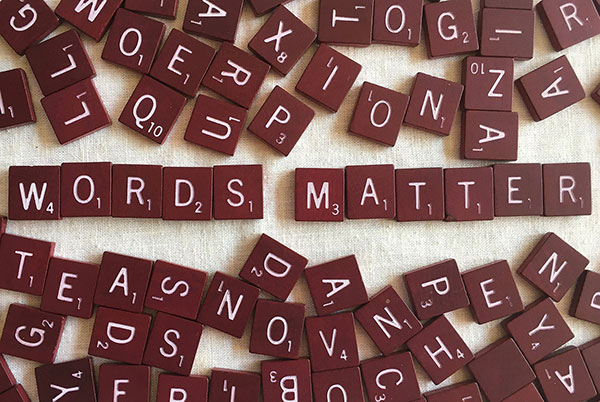
Words have power. They influence how we think and act. They can create labels, misperceptions, and misrepresentations. They can also shape our understanding in meaningful and positive ways.
A few years ago, I had the privilege of facilitating a conversation with Susan H. McFadden, PhD, author of the book Dementia-Friendly Communities: Why We Need Them and How We Can Create Them. During that conversation—which you can watch here—we discussed why words matter, especially in the context of how they can create and perpetuate stigma, shame, and misunderstanding around dementia and aging.
As Susan shares in her book, the Dementia Action Alliance created a wonderful online publication—Words Matter—to address stigmatizing language and develop a new framework of language.
For example, when describing a person living with dementia as “suffering,” a “victim,” or “demented,” harmful barriers and stigma are perpetuated. These words diminish the person to whom they refer.
The preferred rephrasing is “an individual living with dementia.” This helps appropriately reframe the dialogue by recognizing that the individual is living with a condition, nor defined by his or her diagnosis.
The Words Matter publication was created in collaboration with individuals living with dementia, helping to reinforce the message and truth that “individuals are not their condition.” And that “[u]sing appropriate language is a sign of respect, support, and non-discrimination.”
At around the same time that the Dementia Action Alliance was involved in their important work on language, the American Geriatrics Society and other leading age-focused organizations—a coalition known collectively as the Leaders of Aging Organizations—was engaged in similar work around language.
The Leaders of Aging Organizations worked with the FrameWorks Institute, which researched and reported their findings on the disconnect between public perceptions and misunderstandings about aging. Then they addressed how to shift to productive narratives that “advance a view of older age that sees it as a period of challenges and opportunities and counteract the fatalistic view that nothing can be done to improve aging outcomes.”
One result of this work is Reframe Aging, an initiative that is “countering ageism by changing how we talk about aging.” This Initiative offers access to evidence-based tools and training opportunities as the coalition continues “to advocate for changes in public discourse on age.” Ageism is the negative stereotyping of older adults.
Check out these tools and resources from the FrameWorks Institute, offering more appropriate ways to reframe our language about aging. Here’s an example:
- Instead of these words and cues: “Tidal wave,”“tsunami,” and similarly catastrophic terms for the growing population of older people. Try: Talking affirmatively about changing demographics: “As Americans live longer and healthier lives …”
At the heart of this work, I see an encouraging shift from talking about us (older adults) as “others”—a move away from an “us versus them” mentality.
All too often, our society is segmented and siloed by age. Some of this is self-inflicted. In our day-to-day language, I encourage us all to adopt and model a more productive conversation on aging.
The language we use goes a long way to advance more positive associations with aging and encouraging inclusivity. Let’s discourage the use of terms such as (the) aged, (the) elderly, seniors, and senior citizens in our discourse. Why? These words purport discrimination and negative stereotypes about aging, and citizenship is not of concern.
Internalized ageism is common too; this is when we look down on ourselves, often without realizing it. Blaming age when we can’t remember a word (“a senior moment”). Feeling flattered when we’re told “You don’t look [your age]!” Not considering an interesting activity at the senior center because we “don’t want to be around all those old people.”
Stay alert to your own ageist thinking. Reframe your self-talk to avoid stereotypes.
What can be done to reduce internalized ageism? Other cultures celebrate older people. In spite of decades of ageist messages here in the U.S., we change things within ourselves.
- Keep a journal. Be alert to and note remarks you hear that center on someone’s age. Was it positive or negative? If negative, was it based on ageism (a stereotype) or an individual’s actual ability? Stay alert to your own ageist thinking. Reframe your self-talk to avoid stereotypes.
- Identify five things you enjoy about being older.Acknowledge them. Add more age positivity to your life and start reaping the benefits to your personal well-being and quality of life. There’s research that supports this!
For an informative, engaging, and evidence-based read on this subject, check out Breaking the Age Code: How Your Beliefs About Aging Determine How Long & Well You Live by Becca Levy, PhD.
The psychology of aging is getting more attention. In Breaking the Age Code, Dr. Becca Levy, a professor of epidemiology and of psychology at Yale, shares insights from her innovative research and encourages us all to rethink aging. Levy also provides a road map to debunk negative age stereotypes and bolster positive age beliefs.
The reframing of language allows us to be more reflective of our lived reality.
Words matter. Words have power. Let us use them to accurately represent who we are.