
Grief and loneliness following the death of his wife of over 50 years led one of my clients to engage in a lifelong interest in singing. He now regularly practices breathing and singing during our weekly Creative Engagement visits. Not only has he had great improvement in mood, self-confidence, hydration, and even his balance, but my client now regularly performs for fellow residents at his care community! His joy is shared.
We love exploring ways to enrich our clients’ lives through the arts
Creative activity through the arts has been shown to reduce isolation, loneliness, and depression. Arts engagement provides outlets for expressions of personhood and empowers participants to make choices and explore interests.
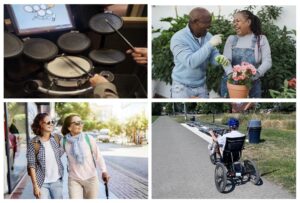
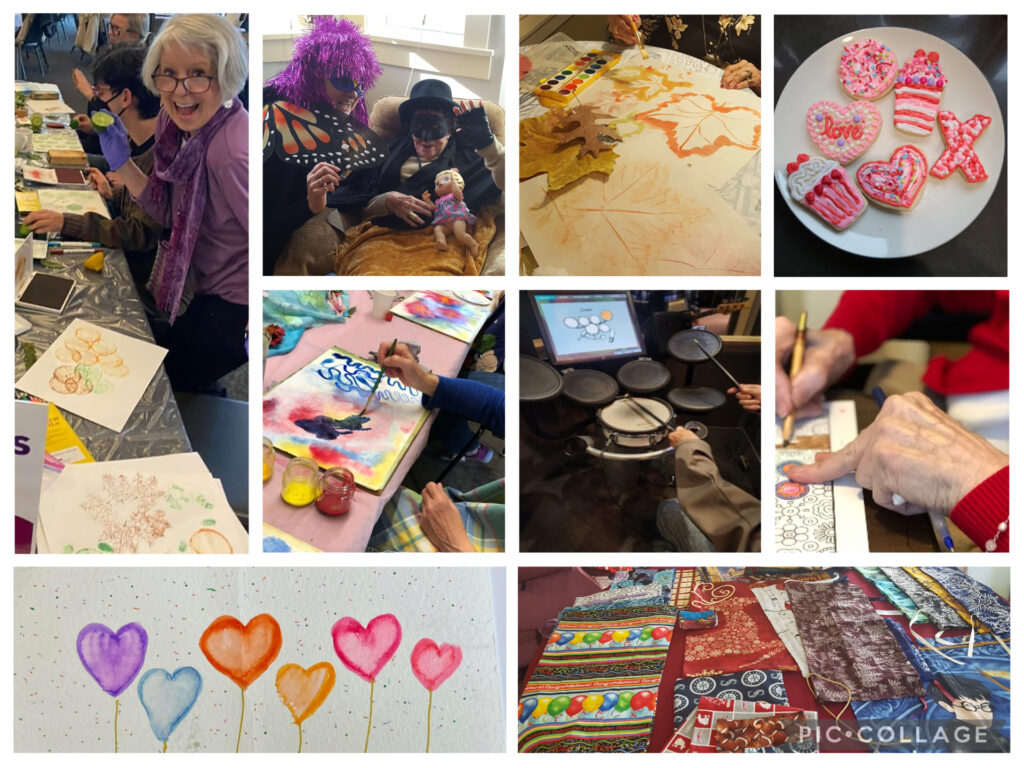
The arts can be experienced in many forms. Dance. Collage. Painting. Drumming. Pottery. Singing. Acting. Writing. Gardening. Knitting. Improv.  Printmaking. Poetry. Sewing. Storytelling. Drawing. Even cooking and baking!
We are also fortunate in the greater Seattle, Bellevue, and south Snohomish County areas to have access to incredible arts engagement programs, many are dementia-friendly and inclusive. (I’ve included links to area programs at the end of this article.)
Some activities may seem mundane or insignificant but are far from that. Each incorporates creativity on the part of client-participants and aids in making meaningful connections, inspiring joy, a sense of purpose, and contentment.
The Power of Nonpharmacological Supports for Individuals Living with Memory Changes
“[P]eople with dementia can contribute to the wider community through their creativity—they do not need to remember, because they can still imagine,” Dr. Susan H. McFadden demonstrates enthusiastically in her book Dementia-Friendly Communities.1 The arts offer limitless opportunities for participation, communication, self-expression, and meaningful connection for individuals living with dementia.
We see this regularly through our work.
One client’s recent move from her single-family home to an assisted living apartment caused extreme anxiety. She felt she had lost her autonomy and independence. With regular visits from a Creative Engagement Specialist colleague, the client received one-on-one attention to express her frustrations and receive validation. My colleague also helped the client to reduce clutter, organize a music player, and hang her favorite art on the walls. The client’s anxiety was reduced when she felt more at home in her new apartment with her art and music, as well as had a routine visit to talk and problem-solve her concerns.
We often use painting and coloring to initiate conversation and reminiscence. One client, who grew up in Kansas, had a love for sunflowers and enjoyed 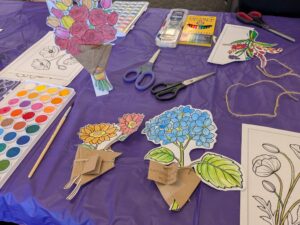 telling stories of how they are called that because the flowers follow the path of the sun, east to west, throughout the day. She also enjoyed using all the oranges, yellows, and greens to color the petals. Crayola has free printable coloring pages for adults that you can download.
Expressing joy through art, another client regularly engages in rock painting with another Creative Engagement Specialist. These art sessions are animated with stories, singing, and plans for sharing their creations. They then take a walk around the neighborhood and leave the artful rocks for others to discover and enjoy.
Another client who lived with late Alzheimer’s disease was a classically trained violinist who loved his visits to symphony matinee performances. A resident of an adult family home, he regularly listened to and watched classical music performances from his iPad, but visits to Benaroya Hall were transformative. It was common for him to hum and move to the music, content and joyful expressions.
“The creative arts are particularly important for people living with dementia because they tap into individual forms of personal expression; as such, there is no right or wrong answer, and the person finds a pathway for success on [their] own terms. Creativity transcends language abilities and is therefore accessible to those who have difficulty with verbal communication.” shares Dr. G. Allen Power in Dementia Beyond Drugs: Changing the Culture of Care.2
Research shows that engaging in the arts for 45 minutes can reduce stress, improve mood, and increase quality of life. Art also brings people together and  can help individuals living with memory loss stay connected to the world around them. All these attributes are occurring as we meet and create together.
The possibilities are endless. Engage the senses. Encourage the use of muscle memory. Don’t be afraid to try something unusual. Have fun! As Dr. McFadden reminds us, “Through the power of the arts, people of all ages, artistic abilities, and cognitive status can come together to tell their stories, laugh and cry together, and experience the joy of celebrating the human spirit of people living with dementia regardless of how advanced the dementia might be.”3
Interested in learning how a Creative Engagement Specialist can enrich the day of someone in your care? Click here to schedule a free, get-acquainted call today to explore how we can bring joy.
ENDNOTES
- McFadden, S. (2021). Dementia-Friendly Communities: Why We Need Them and How We Can Create Them. London, UK: Jessica Kingsley Publishers, p. 173.
- Power, G.A. (2017). Dementia Beyond Drugs: Changing the Culture of Care. Baltimore, USA: Health Professions Press, p. 186
- McFadden, S. (2021), p.186.
Dementia- and Age-Friendly Programs and Activities
King County:
- Broadway Hill Club
- Elderwise
- Frye Art Museum Creative Aging Programs
- Greenwood Senior Center
- Momentia Seattle
- SilverKite Community Arts
- Sound Generations
- The Center for Active Living
- The Memory Hub
South Snohomish County: