

Author: Aging Wisdom

Some physical, emotional, and cognitive changes are likely as we grow older. When these changes interfere with safety, self-care, and personal well-being, it may indicate a need for assistance.
Here are six common signs that reveal an older adult may need help: …
Signs an Older Person You Care About May Need HelpRead More »

A “screening” is a general test to look for signs of a problem. Because early detection makes a huge difference in your ability to recover from any disease or condition, Medicare and Medicare Advantage plans use screening tests for many health issues. Often these tests are 100% covered—no copayments. But you must fit eligibility criteria. The criteria usually involve age, symptoms, and/or a family history that puts you at risk. …

Do you feel defensive when your kids visit? Notice them exchanging knowing glances when you don’t recall a date or name?
Perhaps you feel reluctant to approach them when you do have concerns, because they overreact. So you keep your distance. That isn’t good, either.
It’s a fine line between feeling that your adult children love you and want to protect you, and feeling smothered or even invalidated by them in terms of your competence and self-sufficiency.
Noted geriatrician and author Atul Gawande, MD, observes that while adult children worry most about safety, older adults worry about autonomy and independence. Put another way: Adult children think in terms of “caring for.” Older adults prefer to be “cared about.”
…

It might feel scary to tell others if you’ve been diagnosed with dementia or even just mild cognitive impairment (MCI). Start with those you think will be the most supportive. Perhaps close family and friends. …

May is Aging Life Care Month, an opportunity to celebrate our profession! We love our work.
What is an Aging Life Care Professional (aka Care Manager)?
We are health and human services specialists who act as guides and advocates for individuals and couples who are planning for themselves, and others, such as families, chosen families, and friends caring for older or disabled adults. …
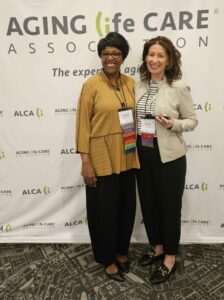
 Today we celebrate our colleague Nicole Amico Kane, Director of Care Management. This month marks Nicole’s ten-year work anniversary at Aging Wisdom.
Nicole oversees our care management team as mentor, director, and visionary leader. She also guides and mentors our University of Washington social work student interns. In addition, Nicole frequently makes informative and empowering presentations in the community.
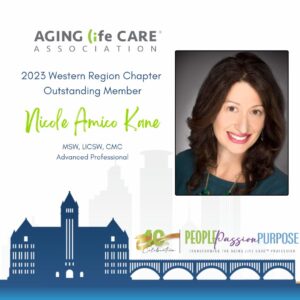 Recently, Nicole was recognized as Outstanding Chapter Member of the Year by the Western Region Chapter (WRC) of our professional association, the Aging Life Care Association (ALCA), during the ALCA annual conference held in Minneapolis. …

The heart of our mission* at Aging Wisdom is to support positive aging and help our clients to live well, care well, and age well. This applies to everyone, regardless of “race, color, gender, gender identity, gender expression, marital status, sexual orientation, political ideology, age, creed, religion, heritage, ancestry, national origin, or sensory, mental or physical ability.”1 …

Your healthcare power of attorney (HCPOA) is an individual you trust to speak for you when you are unable to voice your own decisions: A car accident, surgery, coma, dementia.
In such circumstances, doctors need someone who knows you well and has had conversations with you to guide them in terms of the medical procedures you would or would not want. …

Updated March 4, 2024; previously published April 14, 2021
Being caught in a tax scam can happen to anyone, even though most of us think we’re too smart to get fleeced. Unfortunately, even the most cautious person can get ripped off. When older adults are defrauded, the effects can be devastating.
One insidious fraud making the rounds during tax season involves IRS impersonators. Swindlers claiming to be from the IRS tell intended victims they owe taxes and must pay using a pre-paid debit card, money order or a wire transfer. They threaten those who refuse to pay with a grand jury indictment, immediate arrest, deportation or loss of a business or driver’s license. …
IRS Impersonators & Tax Scams Targeting Older AdultsRead More »

Life plan communities—sometimes called “continuing care retirement communities” (CCRCs)—are private communities that offer residents a full range of care levels, depending on need. For those in independent living, amenities such as a golf course, gym, pool, and tennis and pickle ball courts are typically provided. Some communities even offer college-level classes, a salon, and grocery store. …