

Image courtesy of Allyson Valentine Schrier
Last month, our colleague Wendy looked at the difference between Alzheimer’s and dementia. One of the types of dementia Wendy listed was Frontotemporal Dementia, or FTD.
Frontotemporal Dementia (FTD) is not well-known, but it’s been in the news recently. In February, the family of much-beloved actor Bruce Willis announced that he was diagnosed with FTD.
A year earlier he had been diagnosed with aphasia, a condition that affects the ability to speak and to understand language. The symptoms have since progressed and are no longer limited to difficulty with communication, leading to his more recent diagnosis of FTD.
What is Frontotemporal Dementia or Disorders (FTD)?
FTD results from damage to neurons in the frontal and/or temporal lobes of the brain. According to The Association for Frontotemporal Degeneration, “possible symptoms can result, including unusual behaviors, emotional problems, trouble communicating, difficulty with work, or difficulty with walking.”
Mayo Clinic defines Frontotemporal Dementia as “an umbrella term for a group of brain disorders that primarily affect the frontal and temporal lobes of the brain. These areas of the brain are generally associated with personality, behavior, and language.”
FTD is rare. It tends to be a younger-onset dementia and is the most common of the younger-onset dementias. Roughly 60% of people with FTD are 45 to 64 years old.
The two main forms of FTD are Behavioral Variant FTD (bvFTD) and Primary Progressive Aphasia PPA). With bvFTD, personality, judgement, empathy, and self-control are affected. Memory, unlike with Alzheimer’s, is minimally impacted. PPA impacts communication skills and the ability to speak, write, read, and understand what others are saying. This is the variant that Bruce Willis is living with.
Misdiagnosis is Common
Dr. Bruce Miller, a behavioral neurologist and director of the UCSF Memory and Aging Center, shared in a 60 Minutes interview in 2019 about FTD that because so many cases are first misdiagnosed as mental illness it takes an average of three years and several expensive brain scans to get a correct diagnosis.
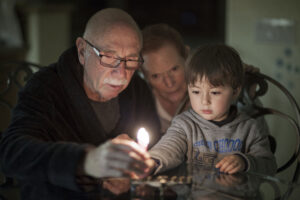
Closer to home, the Schrier family from Issaquah, pictured above, experienced a similar journey. Evan, his wife Allyson, and their sons Ari and Eli, lived for six years with a misdiagnosis of ADD (attention deficit disorder).
After years of uncharacteristic behavior changes and challenges, leaving a Ph.D. program, job losses, and many unanswered questions, Evan was diagnosed with FTD. The diagnosis came only as a result of someone helping Allyson connect the dots.
While the diagnosis was a shock, it also came as a relief to Allyson, who could finally associate Evan’s symptoms and behaviors with a correct diagnosis. This also helped guide the family on a path forward.
Wisdom from a Family Caregiver
Reflecting on what was most helpful to her and her family once Evan had a correct diagnosis of FTD, Allyson shares, “My mission was to make sure that my husband’s needs were met while ensuring that the kids and I popped out the other end of the dementia experience intact.
“Though I am a real DIY kind of person, I owned that I could not do this by myself. Within a month of the diagnosis, I sent email to everyone in our circle: family, friends, acquaintances, former work mates. In that email I explained our situation, and the ways that we might benefit from help.
“The results were fantastic, with people I never would have expected stepping up in hugely helpful ways—taking my husband to the gym, or out for meals so that the kids and I got a break.
“The kids and I had regular therapy sessions. I joined a support group—probably the most important thing I did. I educated myself about my husband’s disease and appropriate ways to support him to avoid, or at least diminish, challenging behaviors.
“UCLA has some great caregiver education videos as does Teepa Snow (and her TikTok videos are superb!). The AFTD has great educational resources. And all family caregivers in Washington State should know about local resources like the Aging and Long Term Support Administration.”
Allyson’s insights are important, sound counsel for any family navigating FTD or another dementia. Get educated. Don’t be shy about seeking help from professionals. Engage the support of others.
As Heming Willis, Bruce Willis’ wife, recently wrote in answer to what others can do, “Don’t ask what you can do, just do” for caregivers or anyone else going through a tough time.
Evan passed away in late February 2019. Allyson’s work as a dementia advocate continues. Recognizing that many doctors lack proper training, and as a result, families often delay treatment and care, and patients often get misdiagnosed, she’s been working to change that.
Today Allyson is Program Manager of the University of Washington Memory and Brain Wellness Center’s Project Dementia ECHO (Extension for Community Healthcare Outcomes), and founder of Zinnia TV, providing more engaging video programming to people with cognitive decline.
Concerned about uncharacteristic behavior or symptoms? Worried you may have Alzheimer’s or another dementia? We can help guide you through the process and work with you to create a tailored plan of care. Click here to schedule a get-acquainted call with one of our Certified Care Managers.